
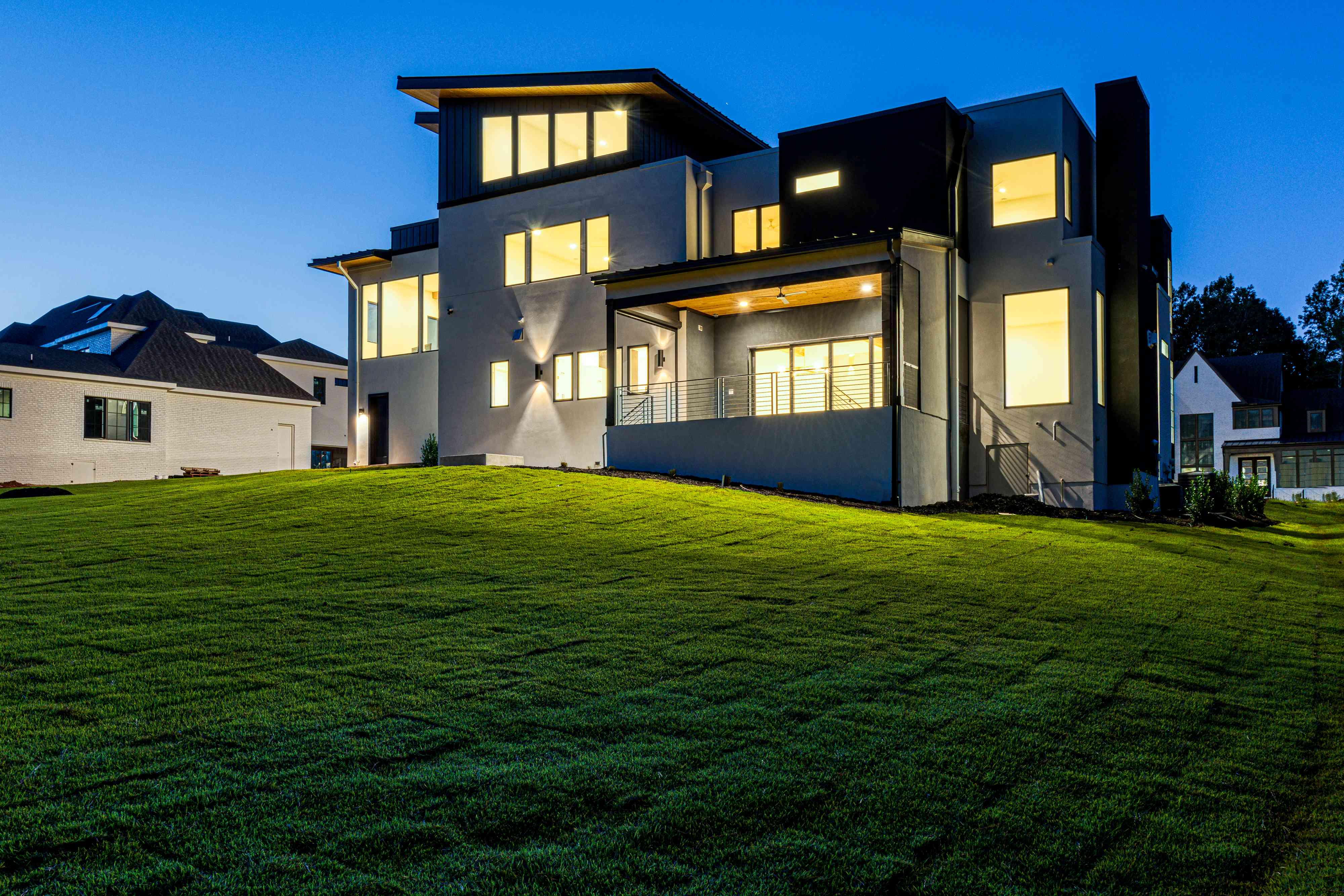
A custom home is the largest, longest, most personal purchase most families ever make — and the builder you choose matters more than the architect, the lot, or the budget. The right builder makes an 18-month project feel orderly. The wrong one turns it into the story you tell at dinner parties for a decade. Here are the twelve questions we'd ask before hiring anyone — including us.
The non-negotiables
1. "Are you licensed for a project this size — and can I verify it?"
In North Carolina, any project over $40,000 legally requires a licensed general contractor. Verify the license yourself — name or number — at the NC Licensing Board for General Contractors. Check that it's active, tiered for your project value (luxury builds need an unlimited license), and clean of disciplinary history. A builder who hesitates here is a builder to walk away from.
2. "Show me three projects like mine — finished, and in person."
Photographs flatter. Walk a finished home and look at what photos hide: miter joints, paint lines at the ceiling, how doors close, tile layout in corners. Then ask to see something built five years ago — quality you can only judge after the house has lived a little. Our portfolio is the starting point; the homes themselves are the proof.
3. "Can I call your last three clients — not your three best?"
Every builder has two glowing references. The telling question for those clients: "What went wrong, and how did the builder handle it?" Something always goes wrong on an 18-month project. You're not hiring for perfection — you're hiring for how problems get handled.
The money questions
4. "Walk me through your pre-construction process."
This is the single most predictive question on this list. Budgets don't fail during construction — they fail before it, in incomplete drawings and vague allowances. A serious builder will describe a deliberate pre-construction phase: design coordination, engineering, real trade pricing, and locked selections before ground breaks. If the answer is "we can start in three weeks," the real price is coming later, in change orders.
5. "Is your pricing open-book?"
Open-book means you see actual trade and supplier invoices, with the builder's fee stated plainly — not a single opaque number with the margin hidden inside allowances. We run open-book on every project because trust survives transparency and rarely survives its absence.
6. "What's in your allowances — exactly?"
The oldest trick in low bidding is thin allowances: $40/yd carpet and builder-grade fixtures in a "luxury" quote. Ask for the allowance schedule line by line, and compare allowances — not totals — across bids. That's usually where a too-good price reveals itself.
7. "How do you handle change orders?"
The answer should be: documented in writing, priced before work proceeds, signed by you, no exceptions. Verbal change orders are how relationships and budgets dissolve together.
The process questions
8. "Who exactly runs my project, and how often will I hear from them?"
The person in the sales meeting is often not the person on your site. Ask who your dedicated lead is, how many projects they carry at once (in luxury work, more than three or four is a warning), and the communication rhythm. You should expect a standing weekly update with photos, schedule, and decisions needed — not silence punctuated by invoices.
9. "Who are your trade partners, and how long have they been with you?"
Finish quality lives in the trades — millwork, tile, plaster, stone. Builders who win work on price shop trades job to job; builders who win on quality keep the same crews for a decade. Ask how long the core trades have been with the firm. Long relationships are the quiet engine of on-time, on-quality delivery.
10. "What does your schedule look like — and what's your on-time record?"
Ask to see a real construction schedule from a current project, then ask what percentage of homes handed over in the last three years hit their contracted date. Builders who measure it will tell you instantly. Builders who don't measure it will tell you a story.
The after questions
11. "What's your warranty — and who answers the phone in year two?"
North Carolina implies certain warranties, but the difference is in service: a structured 11-month walkthrough, a named warranty contact, and a builder who still picks up after the final payment. Ask a past client what happened when something failed eighteen months in.
12. "Why should it be you?"
Then listen. A builder who talks only about price is telling you their strategy. A builder who talks about process, people, and the specific challenges of your lot and brief is telling you theirs. Hire the second one.
You're not buying a house. You're hiring judgment — a thousand decisions made well when you're not in the room.
Red flags worth walking away from
- A bid dramatically below the others. The money is hiding in allowances or coming back as change orders.
- Pressure to skip or rush design. Speed at the start is borrowed from the end — with interest.
- No physical office, no current jobsite to visit, references that all date to one period.
- Vague answers about who supervises your build.
- Contracts without a payment schedule tied to verified milestones.
What strong references should be able to tell you
References are useful only when the questions get specific. Ask past clients whether the person who sold the project stayed involved after contract signing. Ask how often the schedule was updated, whether change orders were explained before work proceeded, and whether the final invoice matched the approved scope. A glowing reference that can only say "they were great" is less useful than a candid one that explains how the builder handled a hard moment.
For a Raleigh custom home, we also want references from similar complexity: infill lots, estate-scale homes, major renovations, pool and outdoor living scopes, or architect-led projects with demanding details. A builder can be excellent at $900K semi-custom homes and still be the wrong fit for a $5M residence with steel, masonry, specialty systems, and a high-touch design team.
Contract signals that predict the project experience
The contract should make the working relationship clearer, not foggier. Look for a defined scope, a transparent pricing structure, insurance requirements, change-order rules, warranty language, schedule assumptions, and a decision process for owner selections. If the proposal depends on vague allowances, missing exclusions, or verbal promises, the real budget is not yet known.
We also recommend asking who has authority to approve substitutions. On a luxury build, a swapped window profile, door hardware line, stone thickness, or trim detail can change the finished character of the home. The builder should have a documented path for approvals so field decisions do not quietly rewrite the design.
The right builder should challenge the brief early
A good builder is not there to say yes to everything. During pre-construction, they should challenge the budget, sequence, constructability, and long-lead assumptions while the project is still flexible. That can feel slower at first, but it is the work that prevents redesign, permit delays, and expensive field fixes. If a builder never pushes back until construction starts, they are not protecting you early enough.
A final gut check before you sign
By the time you choose a builder, you should know who will answer the phone, who will be on site, how decisions are documented, how often the budget is updated, and what happens when something changes. If those answers are still vague, pause. The relationship will not become clearer after excavation starts.
The best builder for a luxury custom home is not simply the one with the best photographs. It is the one whose process makes you calmer after every meeting because the risk is getting smaller, the numbers are getting clearer, and the next decision is obvious.
Frequently asked questions
How do I verify a contractor's license in North Carolina?
Fixed-price or cost-plus — which contract is better?
How many builders should I interview?
Put us through this exact interview.
We wrote this list because we're confident in our answers. Bring it to a consultation — license, references, schedule record, open-book pricing, all of it.
Request a Consultation →